Do We Need a New Renaissance in the Age of AI?

Rediscovering Human Value — and the Mission of Artists
Many people believe that the European Renaissance was simply a revival of classical art.
But I believe it revived something far more profound: the value of being human.
Before the Renaissance, medieval European society was deeply shaped by Christianity. God stood at the center of the universe, and human existence was largely understood through religious faith.
Art reflected this worldview.
Much of medieval painting was not intended to portray human beings as they actually appeared. Its primary purpose was to communicate religious meaning.
In many religious paintings, figures appeared flat, proportions were symbolic rather than realistic, and space lacked the natural perspective we recognize today.
The Virgin Mary, Jesus Christ, and other sacred figures were often depicted according to their religious importance rather than their physical appearance.
The purpose was not necessarily to reproduce the visible world, but to express a spiritual reality beyond it.
In other words, much of medieval art was less concerned with observing the world than with interpreting faith.
Then came the Renaissance.
Beginning in Italy, a profound intellectual and cultural transformation gradually spread across Europe.
People began to rediscover the intellectual achievements of ancient Greece and Rome. Human experience, individual achievement, reason, and the natural world received renewed attention.
This did not mean that religion disappeared. Many of the greatest Renaissance artists remained deeply religious.
What changed was the growing recognition that human beings themselves were worthy of study, respect, and admiration.
And art became one of the most powerful expressions of this transformation.
Artists began studying human anatomy, nature, light, perspective, facial expressions, emotions, and individual character.
They were no longer satisfied with representing religious figures through established conventions. They wanted to capture the complexity of real human experience.
Consider Leonardo da Vinci's Mona Lisa.
Its greatness lies not simply in Leonardo's extraordinary technical skill, but also in his ability to capture the subtle complexity of a human presence.
Her mysterious smile, her expression, and the extraordinary sense of life in her face continue to fascinate us more than five hundred years later.
The Renaissance also brought major developments in linear perspective, anatomy, the representation of light, and the observation of nature.
These achievements were more than technical innovations. They reflected a fundamental change in how people understood themselves and their relationship with the world.
Artists also began to acquire a new social identity.
Rather than being regarded primarily as skilled craftsmen serving religious institutions, leading artists increasingly became recognized as independent thinkers and extraordinary creative individuals.
In medieval Europe, many artists and craftsmen remained anonymous, although some were certainly celebrated in their own time.
By the Renaissance, however, artists such as Leonardo da Vinci, Raphael, and Michelangelo had achieved extraordinary personal fame.
An artist, inventor, and investigator of nature whose work brought together artistic imagination and scientific observation.
His paintings celebrated human knowledge, intellectual inquiry, harmony, and the ideals of classical antiquity.
His extraordinary representations of the human body expressed both physical beauty and spiritual ambition.
Their achievements helped transform not only art, but also the cultural status of the artist.
The Renaissance became an important foundation for the development of the modern world.
It helped create an intellectual environment in which scientific inquiry, individual expression, and new ways of understanding humanity could flourish. These developments would later contribute to the Scientific Revolution, the Enlightenment, and many aspects of modern culture.
In a profound sense, what the Renaissance revived was humanity's confidence in its own potential.
And perhaps that is why Renaissance masterpieces still move us today.
They remind us that human beings can be extraordinarily real, complex, creative, and capable of greatness.
They placed humanity at the center of artistic and intellectual inquiry.
This is one of the defining ideas of what we now call Humanism.
Do We Need Another Renaissance?
Today, I believe we are approaching another historic turning point.
Artificial intelligence is rapidly transforming the way we work, learn, communicate, and create.
Machines can already generate images, compose music, write stories, and perform intellectual tasks that once seemed uniquely human.
And their capabilities will continue to develop.
This raises a fundamental question:
If machines can perform an increasing number of tasks that once defined human intelligence and creativity, how should we understand our own value?
For centuries, we have measured human achievement largely through knowledge, technical skill, productivity, and the ability to create.
But what happens when AI can match or surpass us in many of these areas?
Will we define ourselves by our ability to compete with machines?
Or will we begin to rediscover the qualities that make human life meaningful?
I believe this is where art has an extraordinary opportunity—and an important responsibility.
The Renaissance helped people rediscover the value of human beings in a world dominated by religious authority.
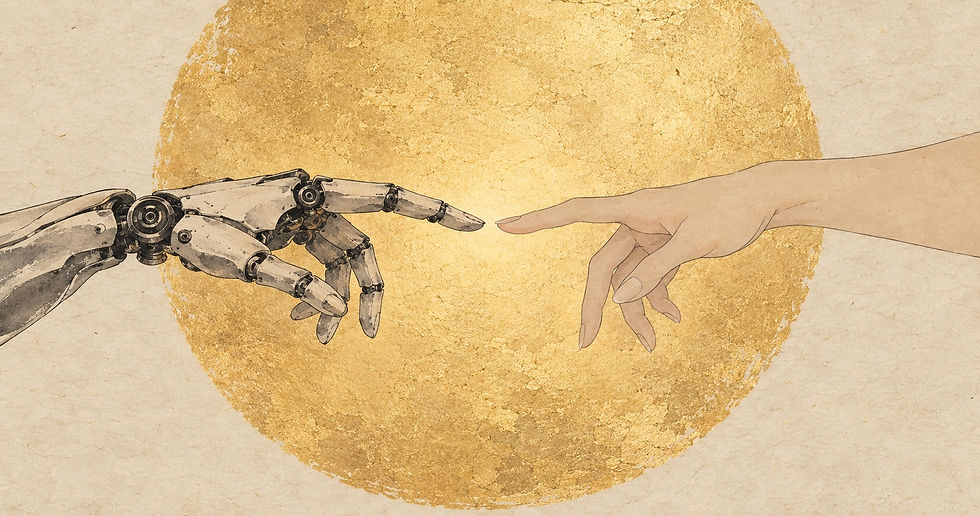
Perhaps the AI era calls for a new Renaissance, one that helps us rediscover human value in a world increasingly shaped by technological intelligence.
But this time, the challenge is different.
We do not need to prove that humans can calculate faster, produce more images, or process more information than machines.
Instead, we need to explore what it means to feel, to experience beauty, to form meaningful relationships, to develop independent judgment, and to discover purpose in our lives.
And artists should be at the forefront of this exploration.
The mission of artists should not simply be to use AI to produce more artwork, nor should it be to reject new technology out of fear.
It should be to explore how technology can expand human creativity while preserving the depth, individuality, and emotional richness of human experience.
How can AI help us become more creative without making our imagination dependent on machines?
How can it expand our knowledge without weakening our ability to think independently?
And how can art help us develop our sensitivity, aesthetic judgment, and spiritual awareness in an increasingly automated world?
These are questions that artists, philosophers, scientists, and society as a whole must confront.
Perhaps the next Renaissance will not be about what humans can create, but about what it means to be human.
The mission of artists in the age of AI may be to help humanity use technology to enrich human life, rather than allowing human value to be defined by technology.
The first Renaissance helped humanity develop a new understanding of its place in the world.
Perhaps a new Renaissance can help us understand our place in a world we now share with artificial intelligence.
And once again, art may have an essential role to play.
The future of humanity should not be a competition against AI. It should be an opportunity to discover a greater expression of our own human potential.